
About Us

ABOUT Narbona
Pass Classic
Early Bird Registration is open! Secure your spot and enjoy special pricing.
The 5K and 10K races will be capped at 400 participants for each event and will go quickly.
History of Narbona
Pass Classic
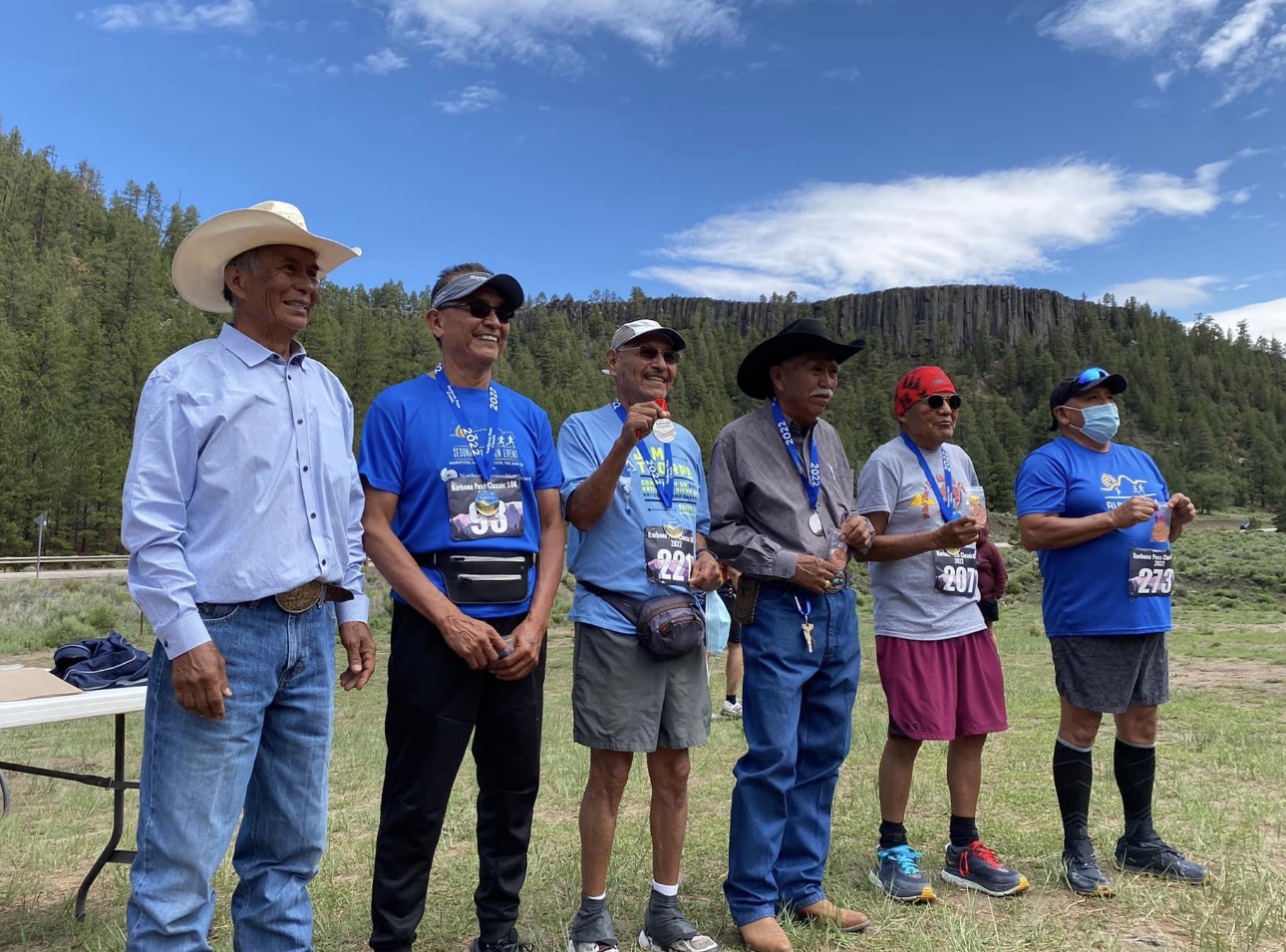
The Narbona Pass Classic race started as Washington Pass Classic, when the Navajo Nation was successful in the name change, the race name changed as well. The Carl family organized the first race in 1979 as a 4-mile run over unimproved horse trails that had been used for centuries. A total 105 runners turned out, when the norm for races was usually about 35 runners, later the race topped 740 runners and was named as one of the top 100 10K Races in the United States by Runner’s World magazine. Realizing the potential, a new 10K course that is known today was mapped out over the blacktop, improved gravel road, former logging road and old trails.
Both the 10K and 5K Race start on black top (highway 134) directly east of the picnic ground with a slight downhill start. Runners run through the picnic ground and pick up the course headed directly to the first challenge. Right before the one-mile point for 10K Runners, and ½ mile point for 5K Runners is ole’ Sandy. This part of the course is an uphill 100-yard stretch of loose sand making it difficult to get traction and momentum, more challenging after running faster than normal through the picnic grounds hearing spectators cheering. After topping Ole’ Sandy is Backbreaker Hill, about 600 yard of steady uphill climb through forested pine. Runners are heard to comment that climb never seems to end, the feeling like the back is going to break, thus Backbreaker Hill. At the crest of Backbreaker Hill is the 1-mile point for the 5K race.
Shortly past the Backbreaker Hill is the turn for the 5K Race that pushes Runner’s downhill, down to the Narbona Pass valley, back on to black top and to the downhill finish line at the picnic ground.
The 10K race continues through forested pines, cottonwoods with two short gradual uphill sections of the course to the 2-mile point. Right past the 2-mile point is the infamous Goat Hill; the course starts as a gradual incline and gets steeper close to the top with loose rocks and uneven footing. In the 1980s, as the elite group was racing, a flock of sheep and goats were grazing nearby. A goat decided to join the race and ran alongside Runners until halfway up, could go no more, accordingly, the hill was named Goat Hill.
Runners cresting Goat Hill get to coast downhill for a short distance before making a circle in the valley as what is known as the “Where the Sun is at” in the Navajo language. Many cheering spectators watch the race with their set-up chairs and help with the water station at the turnaround. The 3-mile point is the right before starting up a short hill that Runners had coasted earlier, this part of the course is where Runners can see who is ahead, and a steady stream of encouragement to each other are heard above the whisper of the wind through the trees.
After cresting the hill, Runners are awarded with a downhill plunge back to the finish. This part of the course is an improved gravel road that is a heavily traveled road connecting families to sheep camps in the Long Lake and Whiskey Lake areas; it also serves as a route to the radar station on top of Narbona Pass. Although, the downhill is a relief for many runners, it is also a struggle for runners that have spent considerable effort on the uphill section of the race and suddenly find little get-go to enjoy the downhill. Most of the closely contested races over the years have won or lost in this section of the race. At the 4-mile point, Highway 134 is visible, once on the highway, Runners find a steady downhill section of the race, past the 5-mile point back to the finish, however, sometimes the steady head wind that tunnels through the canyon of Narbona Pass can be a challenge. At 5 ½ mile point the finish line comes into view, vehicles lining both sides, spectators lining the course, the race announcer exhorting runners to sprint for the finish,
Narbona Pass Classic has been directed towards family and fitness. Race founder Chester Carl as a world class runner invited his competitive runners and many came from all parts of the world, including former Olympians and World Class runners. This was to show local runners that they have the potential to run at the same level. But more importantly, the race provides a time for many that were troubled to set new goals to train for this race, sometimes defeating the demon of alcoholism and drugs by continuing to run and gain new friends. This race is also a proving ground for young Navajo runners to race against the best, getting ready for the High School Cross-Country season or sometimes getting to meet college coaches at the race and getting scholarship for college. For many, it is exciting to watch the youth participate, it is even more exciting to watch the whole family at the starting line and later cross the finish line and see the joy is fulfilling. Narbona Pass Classic serves purpose as a family reunion every year, a great time to spend Fourth of July weekend amongst families and friends who attend. Above all is the renewal of friends, the encouragement; the opportunities for Navajo People to come home from far-away areas to be among Family.
The race record holders are Angela Chalmers from Brandon, Manitoba, Canada, an athlete who competed in the 1500- and 3000-meter running events. She is best known for finishing Third in the 1992 Summer Olympics in Barcelona, Spain. She set the Narbona Pass Classic Women’s 10K course record in 1987 with a time of 40:50, finishing 36th Overall in the race, which still stands today. In 1986, she won the NCAA Division 1 Cross Country Championships for the University of Northern Arizona. This was followed in 1987 when she finished Second place at the Pan American Games in Indianapolis. In 1990, Chalmers won two Commonwealth Games Titles in Auckland, New Zealand, winning both the 1500m and the 3000m in a World leading time of 8:38.38. Four years later, in Victoria, Canada, she failed to defend her 1500m title but did defend her 3000m title in a personal best time of 8:32.17 placing her third on the 1994 World rankings. She remains the only woman in the history of the Commonwealth Games to successfully defend the 3000m race.
Nicholas Kipruto set the Narbona Pass Classic Men’s 10K course record in 2009 finishing with a time of 34:07, a 2005 graduate of Chemelil Sugar Academy, Kenya. Nicholas previously attended Dine College; Nicholas was the men’s individual Champion with a time of 25:14.7. Dine College swept 2008 USCAA Cross Country Championships in Buena Vista, VA. This past year, during the NCAA Track and Field Championship in Des Moines, Iowa, Kipruto finished in 11th in the 5000 meters. His personal best time in 1500 meters is 3:47.98- and 5000-meter time of 13:41.90.